TDS in water refers to the combined amount of minerals, salts, metals, and organic matter dissolved in it, measured in mg/L or ppm. Water with a TDS between 50–150 mg/L is generally considered ideal for drinking; above 500 mg/L is the BIS acceptable limit for Indian drinking water, and above 1200 mg/L is considered unacceptable. High TDS affects taste and can damage appliances; very low TDS strips water of beneficial minerals.
If you’ve ever looked at a water purifier’s display and seen a number followed by “ppm,” you’ve already encountered TDS. This guide covers everything you need to know about TDS in water — what it is, what causes it, why the water TDS level matters, how to test it, and what to do if your reading falls outside the safe range.
What is TDS?
TDS stands for Total Dissolved Solids — the combined concentration of organic and inorganic substances dissolved in water. This includes minerals, salts, metals, and trace organic matter that are too small to be removed by a standard filter and invisible to the naked eye.
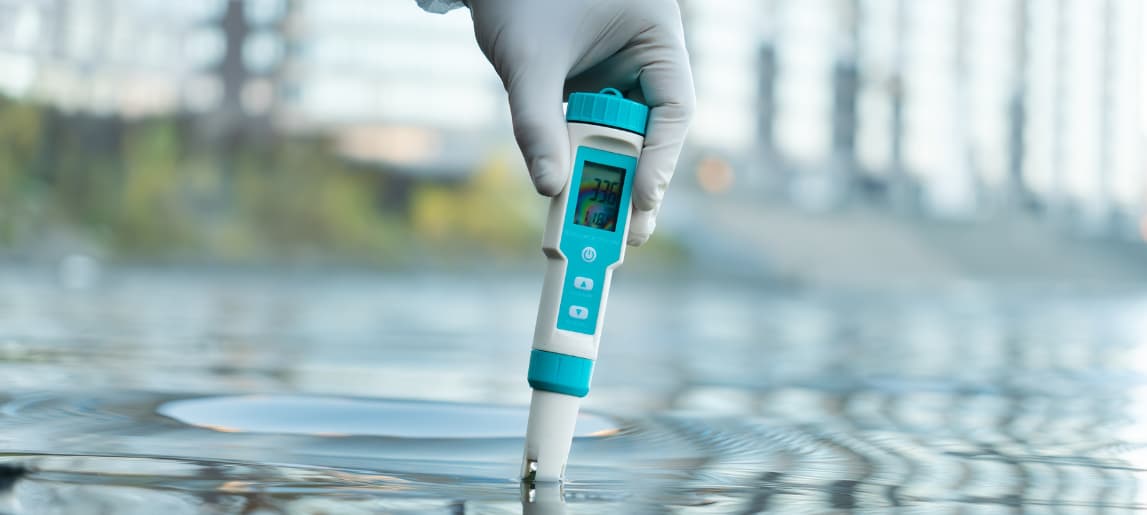
TDS is expressed in milligrams per litre (mg/L), which is numerically equivalent to parts per million (ppm). A TDS meter (also called a TDS pen) estimates this figure by measuring the water’s electrical conductivity: since dissolved ions conduct electricity, a higher conductivity reading corresponds to a higher TDS value.
Is TDS the same as water hardness? No — TDS measures all dissolved substances, while hardness specifically refers to dissolved calcium and magnesium. Water can have high TDS without being “hard,” and vice versa, depending on what’s dissolved in it.
What Causes TDS in Water?
TDS isn’t one single contaminant — it’s an aggregate of everything dissolved in the water. Common sources include:
- Natural minerals: calcium, magnesium, potassium, and sodium bicarbonates that dissolve as water passes through soil and rock
- Runoff and geological contact: water absorbs dissolved solids as it moves through aquifers, riverbeds, and surrounding terrain
- Municipal water treatment: chlorination and other treatment chemicals can marginally raise TDS
- Industrial and agricultural discharge: fertilizer runoff, industrial effluents, and urban stormwater contribute dissolved salts and chemicals
- Household plumbing: aging or corroded pipes can leach metals such as lead, copper, or zinc into tap water
Not all TDS is harmful – in fact, moderate mineral content is what gives water its characteristic taste. The concern arises when TDS levels climb too high, or when the dissolved solids include unsafe contaminants such as heavy metals, nitrates, or arsenic.
Why Does TDS Level Matter?
The water TDS level carries different implications depending on context:
- Drinking water: Elevated TDS can affect taste and, in some cases, signal the presence of unsafe contaminants. Conversely, very low TDS (typically from aggressive RO purification) can strip water of beneficial minerals like calcium and magnesium.
- Industrial processes: Elevated TDS accelerates scale formation in boilers and cooling towers, reduces heat transfer efficiency, and shortens equipment lifespan.
- RO and purification systems: TDS is the primary benchmark used to determine whether water needs treatment, and to what degree.
- Agriculture and irrigation: High-TDS water can gradually alter soil salinity, affecting crop yield over time.
What is a Safe TDS Level for Drinking Water?
There’s no single universal “safe” number — acceptable TDS depends on intended use and which standard you reference (WHO guidance vs. India’s BIS/IS 10500 standard). As a general reference:
TDS Range (mg/L / ppm) | General Quality Rating |
Below 50 | Very low – often over-purified; may lack minerals |
50–150 | Ideal for everyday drinking |
150–300 | Excellent |
300–600 | Good |
600–900 | Fair |
900–1200 | Poor |
Above 1200 | Unacceptable |
Under India’s BIS IS 10500:2012 standard, the acceptable limit for drinking water is 500 mg/L, with a permissible ceiling of 2000 mg/L only when no better source is available. For the complete WHO vs. BIS comparison and what happens at each threshold, read our detailed guide: Ideal TDS Level for Drinking Water: WHO & BIS Standards Explained.
How Do You Measure TDS?
You don’t need a laboratory to get a reasonably accurate reading. Options include:
- Handheld TDS meter (TDS pen): Inexpensive, portable, and gives an instant reading in ppm when dipped into a water sample — the most common method for households.
- Built-in RO purifier display: Most modern RO systems show live TDS output readings, useful for ongoing monitoring.
- Laboratory testing: The most accurate method (gravimetric analysis), recommended for borewell water, suspected contamination, or industrial/regulatory compliance needs.
For the full step-by-step process — including how to get an accurate reading and how often to test — see How to Check TDS of Water at Home: Methods & TDS Meters.
Can You Reduce High TDS?
Yes. The most widely used methods include:
- Reverse Osmosis (RO): Forces water through a semi-permeable membrane, removing the majority of dissolved solids — typically 90–99% depending on membrane quality
- Distillation: Boils water and recondenses the vapor, leaving dissolved solids behind in the boiling chamber
- Deionization (DI): Uses ion-exchange resins to strip dissolved ions, commonly used in industrial and laboratory-grade purification
For industrial and commercial applications — where TDS control protects boilers, cooling systems, and process equipment — a customized, monitored treatment program is usually required rather than a single fix-all method.
Frequently Asked Questions
What does TDS mean in water?
TDS stands for Total Dissolved Solids — the combined amount of minerals, salts, metals, and organic matter dissolved in water, measured in mg/L or ppm.
What is a good TDS level for drinking water?
A TDS level between 50–150 mg/L is generally considered ideal for drinking water, though anything up to 500 mg/L (the BIS acceptable limit) is considered safe for regular consumption.
Is high TDS in water harmful?
Not automatically — but very high TDS (above 900–1200 mg/L) affects taste, accelerates appliance scaling, and can indicate the presence of specific harmful contaminants that warrant separate testing.
Is zero TDS water safe to drink?
Water with near-zero TDS lacks beneficial minerals and can taste flat. It isn’t inherently dangerous for occasional consumption, but it’s not ideal as a long-term primary drinking source without remineralization.
How can I reduce TDS in water at home?
Reverse Osmosis (RO) is the most common household method, typically removing 90–99% of dissolved solids depending on membrane quality.